


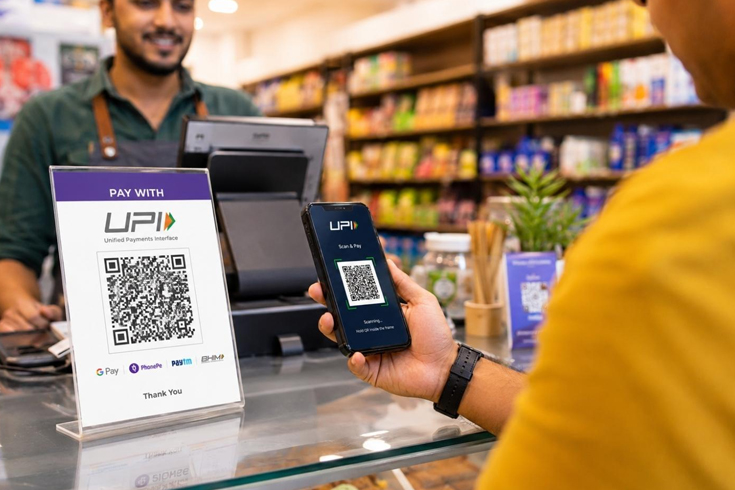
A Nation Waiting for a Bridge
In
the early months of 2016, a peculiar contradiction defined India's economy. It
was home to some of the world's fastest-growing internet and smartphone
adoption rates, yet nearly every transaction — from the tea stall on the street
corner to the neighbourhood grocery store — still moved on paper currency. Bank
accounts existed for millions of Indians thanks to the Jan Dhan Yojana
financial inclusion drive, but those accounts often sat dormant, disconnected
from daily commerce. Cash was still king, and the machinery of digital banking,
when it existed at all, was clunky: multiple apps, mismatched formats, endless
account numbers and IFSC codes, and a general sense that moving money digitally
was something reserved for the tech-savvy few.
It
was against this backdrop that the National Payments Corporation of India
(NPCI), working under the guidance of the Reserve Bank of India, launched the
Unified Payments Interface in April 2016. Few people, even within the banking
establishment, predicted that this quiet piece of financial infrastructure
would go on to reshape the daily lives of thereof hundreds of millions of
Indians, redraw the map of global digital payments, and eventually become a
symbol of India's technological self-confidence on the world stage.
This
is the story of that transformation — not just as a piece of financial
engineering, but as an economic and social force that helped power India's
growth story.
The Idea: One Interface to Rule Them
All
UPI's
founding insight was deceptively simple: money movement between any two bank
accounts should be as effortless as sending a text message. Instead of forcing
users to remember long account numbers or navigate different banking apps for
different purposes, UPI created a single, interoperable layer that sat on top
of India's banking system. A person could link their bank account to a Virtual
Payment Address — something as simple as a name or phone number — and send or
receive money instantly, at any hour, on any day, without the transaction ever
needing to touch a physical branch.
What
made this revolutionary wasn't the individual technology — real-time transfers
existed elsewhere in the world — but the way UPI was designed as public digital
infrastructure. Rather than being owned by a single private company, UPI was
built as an open, interoperable rail that any licensed bank or payments app
could plug into. This decision — to treat payments infrastructure the way a
nation treats roads or electricity grids — would prove to be the single most
important design choice in UPI's history. It meant that a payment initiated on
one app could be received seamlessly by a person using an entirely different
app, with no friction, no extra charges for the user, and no walled gardens.
In
its earliest years, adoption was modest. The initial cohort of banks that went
live in 2016 numbered barely more than twenty, and transaction volumes in that
first year barely crossed a few crore. But the foundation had been laid, and
two forces would soon collide to turn UPI from a promising experiment into an
economic phenomenon.
The Catalysts: Demonetisation, Smartphones, and a Pandemic
Late
in 2016, the Indian government's demonetisation of high-value currency notes
sent a shockwave through the cash economy. Millions of Indians who had never
used a digital payment method were suddenly forced to find alternatives, even
if only temporarily. UPI, still in its infancy, was one of the beneficiaries of
this scramble toward digital alternatives, alongside mobile wallets and card
payments.
But
the truly decisive catalyst was the plunge in the cost of mobile data that
followed the entry of a new telecom operator into the Indian market later that
decade. Data that had once been a luxury became astonishingly cheap, and
smartphone penetration accelerated across small towns and rural India, not just
metropolitan centres. Suddenly, a farmer in a village, a small shopkeeper in a
Tier-3 town, and a gig worker in a metro city all had, in their pocket, the
tools needed to send and receive money instantly.
Then
came the COVID-19 pandemic. As lockdowns forced people to avoid handling cash
and physical contact, UPI's zero-fee, contactless, instant nature made it the
default choice for millions of new users almost overnight. Vegetable vendors
who had never touched a QR code began pasting laminated UPI codes on their
carts. Auto-rickshaw drivers who once haggled over exact change started asking
passengers to simply "scan and pay." What began as a public health
necessity cemented itself as a permanent behavioural shift.
By
the time the pandemic eased, UPI was no longer a convenience — it had become
the default grammar of everyday commerce in India.
The Numbers That Tell the Story
The
scale UPI eventually reached is almost difficult to comprehend. According to
NPCI's own data, the platform's network expanded from around 21 participating
banks at launch in 2016 to well over 700 banks live on the system a decade
later. Annual transaction volumes, which stood at a modest 92 crore
transactions in the 2017-18 financial year, exploded past 24,000 crore
transactions in the 2025-26 financial year — a scale-up of a magnitude rarely
seen in any payments system anywhere in the world.
By
late 2025, UPI was processing more than 2,000 crore (20 billion) transactions
in a single month, a threshold it crossed for the first time in August of that
year. December 2025 set a fresh record with over 21.6 billion transactions
worth nearly ₹28 lakh crore in that month alone, and by March 2026, monthly
volumes had climbed even higher, touching roughly 22.6 billion transactions.
Year-on-year, transaction volumes across 2025 grew by over 30 percent, even as
the value of transactions grew at a slightly slower pace — a telling sign that
UPI's growth was being driven not just by big-ticket transfers but by an
explosion of small, everyday retail payments: the ₹20 chai, the ₹150 grocery
bill, the ₹500 auto fare.
Today, UPI accounts for roughly 85 percent of the total volume of India's retail digital payments, dwarfing cards, net banking, and wallets combined. Perhaps most striking of all is India's position on the world stage: by 2026, India alone was estimated to account for close to half of all real-time digital payment transactions processed globally — more than three times the share of Brazil's well-regarded Pix system, which is often cited internationally as UPI's closest global peer. The International Monetary Fund itself has publicly recognised UPI as the world's largest real-time payments platform by transaction volume, a rare instance of a developing economy's public infrastructure earning explicit global institutional praise.
Financial Inclusion: The Quiet
Revolution
Numbers
alone do not capture what UPI has meant for ordinary Indians. Before UPI, a
street vendor accepting only cash was, in an important sense, invisible to the
formal economy — no transaction record, no credit history, no digital footprint
that a bank or lender could use to assess creditworthiness. UPI changed this
quietly but profoundly. As small merchants began accepting digital payments by
the millions, they began generating a transaction history for the very first
time. This data trail has, in turn, become the foundation for a new generation
of fintech lending products, allowing small businesses that never had access to
formal credit to be assessed and financed based on their real cash flows rather
than collateral they didn't have.
Migrant
workers sending money home to their families no longer need to rely on informal
money-transfer agents who might charge steep fees or introduce delays. A worker
in a city can transfer wages to a spouse in a village within seconds, at no
cost, using nothing more than a basic smartphone. This has been particularly
significant for India's vast unorganised labour force, for whom every rupee
saved on transaction costs is a meaningful gain.
Small
and medium enterprises, too, have benefited enormously. The elimination of
cash-handling costs — the time spent counting notes, the risk of theft, the
friction of making change — combined with instant settlement into a business's
bank account, has streamlined operations for millions of small traders.
Government welfare disbursements, too, increasingly move through digital rails
connected to this broader ecosystem, reducing leakage and ensuring subsidies
reach intended beneficiaries more directly.
Powering the Formal Economy
Economists
studying India's growth trajectory have pointed to UPI as one of the more
understated contributors to the formalisation of India's economy. When cash
transactions move into a digital, traceable system, a portion of what was once
undocumented economic activity becomes visible to tax authorities and financial
institutions. This has implications for everything from GST collections to the
broader tax base, even if isolating UPI's precise contribution from other
simultaneous reforms remains a matter of ongoing economic debate.
The
platform has also acted as a springboard for India's broader fintech industry.
Companies built entirely around UPI rails have grown into some of the country's
most valuable technology firms, and traditional banks have had to reinvent
their consumer-facing technology to keep pace. An entire ecosystem of
point-of-sale devices, QR code merchants, payment gateway providers, and app
developers has grown up around UPI's open architecture — creating employment
and business opportunity that didn't exist a decade earlier.
Carrying
UPI to the World
Having
achieved dominance at home, India's ambitions for UPI increasingly turned
outward. NPCI International Payments Limited was set up specifically to extend
UPI's rails and philosophy beyond India's borders. By the mid-2020s, UPI-linked
or UPI-inspired QR payment acceptance had extended into a growing list of
countries — including the United Arab Emirates, Singapore, France, and several
others — allowing Indian travellers abroad to pay using the same QR-based
system they use at home, and in some cases allowing those countries to explore
UPI-style rails for their own domestic payment ecosystems.
Cross-border
person-to-person payment corridors have also begun to emerge, connecting India
with neighbouring countries such as Nepal, allowing remittances to move with
the same speed and low cost that has become the hallmark of UPI within India.
These developments matter not merely as a matter of convenience for travellers,
but as a demonstration of India's growing confidence in exporting its own
digital public infrastructure as a model for other developing nations — a
marked shift from the historical pattern in which payment technology and
standards were typically imported from the West.
The Road Ahead: Scale, Security, and
Sustainability
UPI's
success has not come without challenges. The system's zero merchant discount
rate policy on person-to-merchant transactions — a deliberate choice to keep
UPI free for small merchants and encourage adoption — has fuelled explosive
growth, but it has also raised persistent questions about the long-term
commercial sustainability of the ecosystem, prompting ongoing debate among
policymakers, banks, and payment app operators about how the infrastructure
should be funded over time.
The
sheer scale of daily transaction volumes — now exceeding 700 million
transactions on an average day — has also placed real operational stress on the
underlying infrastructure. Occasional outages during peak shopping periods have
underscored the need for continued investment in resilience and redundancy.
Fraud, too, has grown alongside adoption, with social-engineering scams
targeting less digitally literate users becoming a recurring concern for
regulators and banks alike, even as fraud losses as a share of overall
transaction value have, according to some industry reports, shown signs of
improvement through stronger authentication and consumer awareness efforts.
There
is also the matter of market concentration: a small number of private apps
continue to handle the overwhelming majority of UPI transaction volume,
prompting regulatory efforts to encourage a more diverse ecosystem of players,
so that no single player's technical failure could disrupt the payment habits
of hundreds of millions of people at once. Encouragingly, by mid-2026 there
were early signs of this diversification taking hold, as smaller apps began
chipping away at the combined dominance of the two largest players for the
first time since app-level reporting began — a small but meaningful shift
toward a healthier, more resilient market structure.
The Human Face of the Revolution
Behind
every statistic in UPI's story is a small, human moment of friction removed. It
is the fruit seller who no longer needs to keep a tin of loose change, freeing
up capital that once sat idle as coins. It is the college student living away
from home for the first time, splitting a dinner bill among five friends
without anyone needing to carry cash or "settle up later." It is the
elderly parent who can now receive money from a child working abroad within
seconds, rather than waiting days for a bank transfer to clear. It is the small
kirana store owner who can finally apply for a working-capital loan because,
for the first time, a lender can see six months of verified sales flowing through
their account.
None
of these moments individually would make headlines. But multiplied across
hundreds of millions of Indians, day after day, they represent something closer
to a quiet redistribution of time, trust, and opportunity — the kind of structural
change that rarely announces itself but reshapes an economy from the ground up.
A Decade That Changed How India Pays
What
began in 2016 as an ambitious but uncertain experiment in interoperable digital
payments has, within a single decade, become the backbone of daily economic
life for hundreds of millions of Indians — and a genuine source of national
pride. UPI did not merely digitise an existing system; it created an entirely
new grammar for how value moves between people, businesses, and institutions in
India, doing so at a scale and a level of accessibility that few, if any, other
nations have matched.
Its
story is, in many ways, the story of modern India itself: a young population
rapidly adopting new technology, a state willing to invest in public digital
infrastructure as a genuine public good rather than a private monopoly, and an
economy finding its own path to formalisation and financial inclusion rather
than simply importing models built elsewhere. As India looks toward the next
decade of UPI's evolution — carrying its rails to new countries, deepening
financial inclusion at home, and navigating the challenges of scale and
sustainability — one thing is already clear: UPI has given India something rare
in the history of global technology — a homegrown innovation that the rest of
the world is now studying, and in some cases, seeking to emulate.





.jpg)