

The Boy Who Watched the Sky
In
a small town in India, a boy once sat on his rooftop every night, staring at
the stars, wondering if people like him — with no fancy resources, no foreign
degree, no big-city upbringing — could ever be part of something as grand as
space exploration. He didn't know it then, but the answer to his question was
already being written, quietly, patiently, in the labs and launch pads of the
Indian Space Research Organisation.
That
boy could have been anyone. He could have been a girl in a village in Bihar, a
student in Chennai, or a young engineer in Ghaziabad. Because that is the real
story of ISRO — not just of rockets and satellites, but of ordinary Indians
proving, again and again, that extraordinary things are possible when belief
meets discipline.This is the story of the last decade — a decade in which ISRO
did not just reach for the stars, it redefined what a resource-constrained,
self-reliant nation could achieve when it dared to dream big.
Where It All Began: The Confidence Built by Mangalyaan
To
understand the last ten years, we must start just before them — in 2014, when
India's Mars Orbiter Mission, popularly called Mangalyaan, entered orbit around
the Red Planet on its very first attempt. No other nation in the world had
managed this feat on a maiden try. It cost less than the budget of a Hollywood
space film, yet it outperformed missions that had cost many times more.
Mangalyaan
was not just a scientific triumph. It was a psychological one. It told an
entire generation of Indian scientists, and an entire generation of Indian
children, that being resource-conscious was not a weakness — it was a
superpower. It planted a seed of confidence that would blossom spectacularly
over the next ten years.
2017: The Year India Broke the World Record
Fast
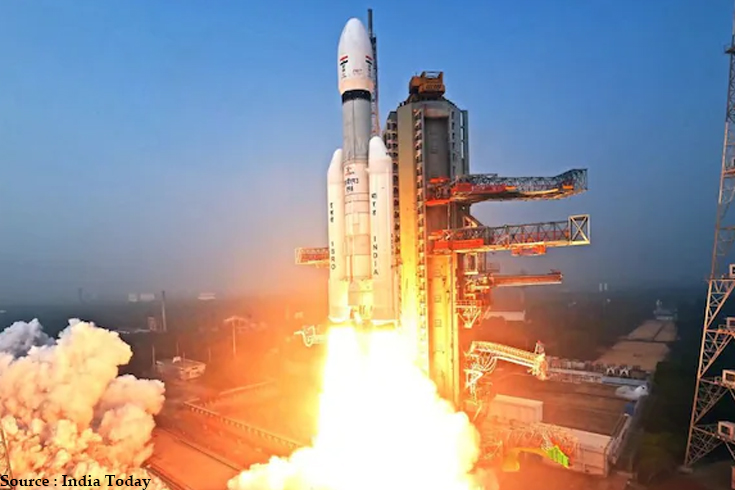
forward to February 2017. At the Satish Dhawan Space Centre in Sriharikota,
scientists and engineers stood watching a single rocket — the PSLV-C37 — carry
not one, not ten, but 104 satellites into orbit in a single launch. It was, at
the time, the largest number of satellites ever launched by any country in a
single mission.
Imagine
the precision this demanded. Each satellite had to be released at the exact
right moment, in the exact right sequence, at the exact right velocity, so that
none of them collided with each other as they fanned out into their designated
orbits. It was like threading 104 needles simultaneously while moving at
thousands of kilometres per hour. India did it, and the world took notice.
This
was the moment ISRO firmly established itself not just as a space agency
chasing its own ambitions, but as a trusted, cost-effective launch partner for
the world. Nations began queuing up to have their satellites carried into orbit
on Indian rockets, because ISRO had proven it could do more, for less, with
more reliability than almost anyone else on the planet.
Chandrayaan-2: The Sting of Disappointment That Never Became Defeat
Not
every chapter in this decade was one of unbroken triumph, and it is important
that young Indians understand this too — because resilience is as much a part
of ISRO's story as success.
In
September 2019, the nation held its breath as the Vikram lander of
Chandrayaan-2 began its descent towards the lunar surface. For a while, it
seemed India was about to become only the fourth country in history to achieve
a soft landing on the Moon. Then, just kilometres from the surface, contact was
lost.
The
images of ISRO Chairman Dr. K. Sivan being consoled by the Prime Minister,
tears in his eyes, became etched into the memory of a billion Indians. But what
happened next is what truly matters. Instead of retreating into disappointment,
ISRO's scientists went back to their drawing boards. They studied every
millisecond of data from the failed landing. They rebuilt, redesigned, and
refined their systems. The orbiter of Chandrayaan-2, meanwhile, continued its
work flawlessly, delivering some of the finest lunar imagery and scientific
data the world had ever seen, and it continues to serve the mission that would
come next.
This
is the lesson our young generation must carry forward: failure is not the
opposite of success — it is often the raw material from which success is built.
Chandrayaan-3: The Moment India Touched the Moon
On
the evening of 23rd August 2023, the entire country came to a standstill.
Streets were empty. Classrooms had paused their lessons. Offices had switched
their screens to a live broadcast. Every eye in India, and many across the
world, was fixed on a single descending spacecraft.
When
Vikram's legs touched the lunar surface near the Moon's south pole — a region
no other nation had ever managed to reach — the control room erupted. India had
become only the fourth country in the world to achieve a soft lunar landing,
and the very first to do so near the lunar south pole, a region believed to
hold precious deposits of water ice that could one day support future space
missions.
The
date, 23rd August, is now celebrated every year as National Space Day. It is a
day set aside specifically to remind the youth of this country of what is
possible. The rover named Pragyan, meaning wisdom, rolled out onto the lunar
surface and began sending back data that added meaningfully to humanity's
understanding of the Moon.
What
makes this achievement even more remarkable is its cost. Chandrayaan-3 was
executed on a budget that was a fraction of what other spacefaring nations
spend on comparable missions — a testament to the ingenuity, discipline, and
frugal brilliance that has become ISRO's signature.
Aditya-L1: Chasing the Sun
Barely
five months after the Moon landing, ISRO turned its gaze towards an even more
ambitious target — the Sun. On 6th January 2024, Aditya-L1 was successfully
placed in a halo orbit around the Lagrange Point 1, a gravitationally stable
location roughly 1.5 million kilometres from Earth.
From
this vantage point, Aditya-L1 continuously observes the Sun's corona, its magnetic
fields, and the solar winds that can affect satellite communications and power
grids back on Earth. India became one of a very small number of nations with a
dedicated solar observation mission stationed at this precise location — a
scientific outpost quietly watching over our star, and by extension, watching
over us.
SpaDeX: Learning to Dance in Orbit
In
January 2025, ISRO achieved something that only a handful of space powers in
the world have ever demonstrated — the ability to dock two spacecraft together
in orbit. The Space Docking Experiment, known as SpaDeX, saw two small
satellites nicknamed Chaser and Target manoeuvre with astonishing precision,
approach one another in the vastness of space, and successfully dock and later
undock autonomously.
This
might sound like a small technical milestone, but its implications are
enormous. Docking technology is essential for building space stations, for
refuelling satellites in orbit, and for future human spaceflight missions where
crew modules must connect with other spacecraft. With SpaDeX, India joined an
elite club of nations that have mastered this delicate orbital dance.
Reaching for Humans in Space
The
decade also carried India steadily closer to its most human ambition yet —
sending its own astronauts into space aboard an Indian rocket, through the
Gaganyaan programme. Test vehicle flights, crew escape system trials, and
rigorous astronaut training have all been progressing, building the foundation
for India's first human spaceflight.
Alongside
this, in June 2025, Group Captain Shubhanshu Shukla became part of a
significant milestone when he travelled to the International Space Station as
part of a commercial mission, interacting with scientists, conducting
experiments, and even speaking with the Prime Minister from orbit — a moment
that brought the dream of an Indian in space vividly alive for millions of
young viewers watching from home.
NISAR: A Handshake with the World
In
July 2025, a satellite years in the making, born out of a landmark
collaboration between ISRO and NASA, finally lifted off. NISAR is designed to
monitor Earth's surface with extraordinary precision, tracking changes as small
as a few millimetres — critical for understanding earthquakes, glacier
movements, and natural disasters before they strike, or as they unfold.
This
mission stands as proof that ISRO is no longer just a participant in the global
space community; it is a respected, sought-after partner, trusted by the
world's most advanced space agencies to co-build technology that benefits all
of humanity.
The Numbers That Tell the Quiet Story
Behind
every headline-making launch lies a quieter story of scale and consistency.
Over the decades, India has sent up more than 4,000 rockets and well over a
hundred satellites, steadily building indigenous capability in cryogenic
engines, semi-cryogenic propulsion, and advanced satellite systems. Milestones
once thought impossible for a developing nation — the fastest maiden flight of
a cryogenic-stage rocket, breakthroughs in semi-cryogenic engine welding,
satellites that carry the best lunar cameras in the world — have become part of
ISRO's everyday vocabulary.
Why This Story Belongs to Every Young Indian
It
would be easy to read all of this as simply a list of ISRO's achievements. But
that would miss the point entirely. This is not merely ISRO's story — it is
India's story, and more specifically, it is the story of what young Indians are
capable of when they are given the chance to dream without limits.
The
scientists who built Chandrayaan-3, who calculated the trajectory for
Mangalyaan, who designed the docking mechanism for SpaDeX, were not born
extraordinary. Many of them grew up in small towns, studied in government
schools, dealt with power cuts while preparing for their engineering entrance
exams, and had no guarantee of success. What they had was curiosity,
discipline, and an unwavering belief that India could compete with, and even
surpass, nations with far greater resources.
Today,
as India looks ahead to landing an astronaut on the Moon by 2040, building its
own space station, and contributing to humanity's next great leap into the
cosmos, it needs its youngest minds to pick up where this decade left off. It
needs the student solving physics problems by lamplight, the young girl building
small robotics projects in her school lab, the college student writing her
first lines of satellite software, to know that the path from where they stand
to where ISRO stands today is not as long as it seems.
Because
a decade ago, a nation that had once struggled to be taken seriously in the
global space race stood at the edge of the Moon's south pole and planted its
flag. It listened to the Sun's whispers from a million and a half kilometres
away. It taught two satellites to dance together in the silence of orbit.
If a nation with modest resources and enormous dreams can do all this in ten years, imagine what the next ten years — powered by the curiosity of today's children — could achieve. The sky, quite literally, is no longer the limit. It is only the beginning.








.jpg)
