


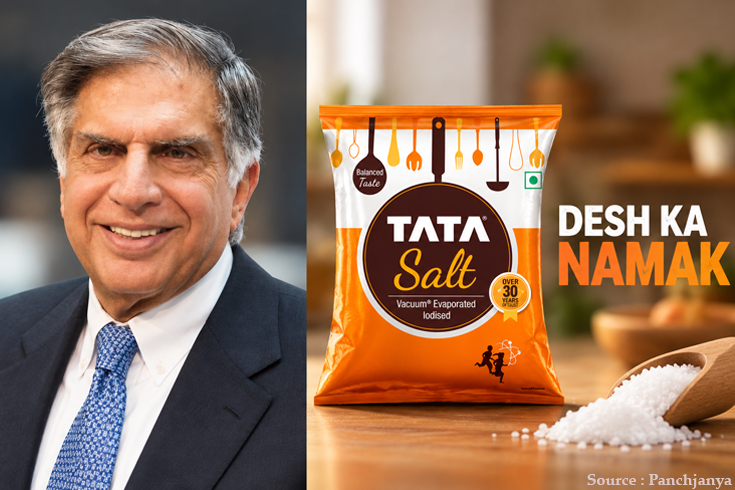
A Pinch of History That Changed a Nation
Walk
into any kitchen in India — a tiny one-room flat in Dharavi, a farmhouse in
Punjab, a bungalow in Bengaluru — and there is a good chance you will find the
same small blue packet sitting quietly on the shelf. It doesn't announce
itself. It doesn't need to. For more than four decades, that unassuming pack
has been doing something remarkable: quietly protecting the health of an entire
nation, one meal at a time.
This
is the story of Tata Salt — how a simple mineral became one of India's most
trusted brands, how it changed public health forever, and how the House of Tata
turned something as ordinary as salt into something extraordinary.
Before 1983: A Market Without a Name
It's
hard to imagine today, but there was a time when salt in India had no brand at
all. It was sold loose, scooped out of open sacks in the local grocery store,
with no promise of purity, no guarantee of quality, and — critically — no
iodine. Iodine deficiency was a silent public health crisis in India,
responsible for goitre and other serious health problems affecting millions,
especially in the country's interior regions far from the sea.
Into
this unbranded, unregulated market walked Tata Chemicals in 1983 with an idea
that seemed almost too simple to matter: what if salt had a name people could
trust? What if the humble crystal on your dinner table came with the same
promise of integrity that the Tata name had carried since the days of Jamsetji
Tata?
That
year, Tata Salt was born — the first nationally branded, iodised salt in India.
The tagline that followed it — "Namak ho toh Tata ka" ("If it's
salt, let it be Tata's") — became one of the most recognised jingles in
Indian advertising history. But behind the catchy tune was a genuinely
pioneering idea: salt made using vacuum evaporation technology, untouched by
human hands during processing, refined to a level of purity that loose salt
simply could not match.
The Ranking That Matters: India's Salt of Choice
Numbers
rarely capture the emotional weight of a brand, but in Tata Salt's case, they
tell a story of their own. Tata Salt has held the position of India's largest
and most trusted salt brand for decades, commanding more than 25 per cent of
the overall salt market in the country, while being roughly four times larger
than its nearest competitor. Within the branded salt segment specifically — the
part of the market made up of packaged, quality-assured salt rather than loose,
unregulated salt — Tata Namak's share has been estimated at around 40 per cent,
making it the undisputed category leader.
Perhaps
the most telling statistic of all is one about memory rather than market share:
eight out of every ten Indians, when asked to name a salt brand, think of Tata
Salt first. In a country of over a billion people, speaking dozens of languages
and spanning wildly different regional cuisines, that kind of universal recall
is almost unheard of. It places Tata Salt in the rare company of brands like
Xerox and Colgate — names so dominant that they have, in everyday conversation,
become almost synonymous with the product category itself.
On a global scale, this makes Tata Salt one of the largest branded salt products by household reach anywhere in the world, simply by virtue of serving the second-most populous nation on Earth. Few packaged food brands, in any country, can claim a footprint stretching into over 900 million potential consumers across more than 200 million households.
More Than a Product — A Public Health Mission
What
sets Tata Salt apart from an ordinary consumer brand is that its origin story
was never really about profit margins. It was about goitre.
In
the early 1980s, iodine deficiency disorders were rampant across large parts of
India, particularly in the sub-Himalayan belt and other regions far from
coastal areas where iodine occurs naturally in the diet. Goitre, stunted growth
in children, and cognitive impairment were all linked to the absence of iodine
in everyday food. The Indian government had begun pushing for universal salt
iodisation, but implementation on the ground was patchy at best, especially in
a market where the overwhelming majority of salt sold was loose and unbranded.
Tata
Salt stepped into this gap not merely as a business opportunity but as
something closer to a public health campaign wrapped in a retail product. By
guaranteeing iodine content and consistent quality in every packet, the brand
made it possible for public health messaging around iodine deficiency to
actually translate into real dietary change at scale. Decades later, India has
made extraordinary progress on this front — the vast majority of Indian
households today consume adequately iodised salt, a shift that public health
experts credit in large part to the widespread adoption of quality branded salt
led by Tata.
This
is, in many ways, the quiet secret of Tata Salt's success: it built an
emotional and functional bond with Indian families by literally caring for
their health before it ever asked for their loyalty. The brand's own promise —
"Desh ki Sehat, Desh ka Namak" ("The Nation's Health, The
Nation's Salt") — is not just a marketing line. It's a fairly accurate
summary of what the brand set out to do.
Tata: The Name Woven Into Indian Life
To
understand why a packet of salt could become a symbol of national trust, you
have to understand the House of Tata itself. Few business houses anywhere in
the world are as deeply embedded in the everyday life of a country as the Tata
Group is in India.
Think
about an ordinary day for millions of Indian families, and Tata is quietly
present at almost every turn. You might wake up and check the time on a phone
charged with power partly generated by Tata Power. Your morning cup of tea may
well be Tata Tea (or Tetley, which Tata owns internationally). You commute to
work in a Tata Motors vehicle — perhaps a Tata Nexon or an Indica, or on public
transport built with Tata engineering. Your office building might have been
constructed with Tata Steel. Your company's software may run on systems built
by Tata Consultancy Services, one of the largest IT services firms in the
world. In the evening, you might unwind watching a show, checking messages, or
shopping — all supported, in some corner of the infrastructure, by a Tata-owned
or Tata-invested enterprise. And through it all, dinner is seasoned with Tata
Salt.
This is not an exaggeration for effect — it's simply how deeply the conglomerate's roots run through Indian daily life. The Tata Group's presence spans steel, automobiles, technology, aviation (through Air India), hospitality (through the Taj group of hotels), power, chemicals, and consumer goods, among many other sectors. Few families in urban or rural India go a full day without touching a Tata product or service in some form.
What
makes this reach even more remarkable is the reputation the Tata name has
cultivated over more than 150 years. Founded by Jamsetji Tata in the 19th
century, the group has long been associated with a rare combination in the
corporate world: scale paired with a genuine sense of social responsibility.
Tata companies have historically ploughed significant profits back into
philanthropy, education, healthcare, and community development through Tata
Trusts, which hold substantial ownership stakes in the parent company itself.
This isn't just corporate positioning — it's structurally built into how the
Tata Group operates, and Indian consumers have sensed this authenticity over
generations.
It
is precisely this decades-long reservoir of trust that Tata Salt tapped into when
it launched in 1983. The brand didn't have to convince Indian households that
Tata as a name stood for quality and integrity — that reputation already
existed. What Tata Salt had to do was prove that the promise could extend even
to something as small, as inexpensive, and as easily taken for granted as salt.
And prove it, it did.
What Tata Salt Teaches Us About Building Something That Lasts
Strip
away the market share figures and the advertising jingles, and the Tata Salt
story leaves behind a handful of lessons that feel almost timeless — the kind
of lessons that apply as much to a small entrepreneur starting a business today
as they did to a large conglomerate entering an unbranded market in 1983.
The
first lesson is about identifying a real problem before chasing a market
opportunity. Tata Chemicals didn't set out to simply sell salt more cleverly
than everyone else; it set out to solve a genuine, widespread health crisis.
The commercial success followed the social purpose, not the other way around. That
order of priorities is rare, and it is arguably the single biggest reason the
brand earned such deep, generational trust.
The
second lesson is about the quiet power of consistency. Tata Salt did not
reinvent itself every few years chasing trends. Its core promise — purity,
iodine content, and reliability — remained remarkably stable even as the
packaging, advertising, and product range evolved around it. In a marketplace
where brands often rise and fall within a decade, four decades of stable trust
is an extraordinary achievement.
The
third lesson is about accessibility. A brand can only build a lasting
relationship with a billion people if it is actually within reach of a billion
people — geographically and financially. Tata Salt's decision to keep pricing
sensible and its distribution network expansive, reaching into the smallest
villages alongside the largest cities, ensured that the promise of purity
wasn't a luxury reserved for the wealthy. It was, quite literally, everyone's
salt.
Salt as a Symbol of Something Bigger
There
is something quietly beautiful about the idea that one of India's most trusted
brands isn't a flashy smartphone or a luxury car, but a basic kitchen staple
that costs a family only a few rupees. Salt is, after all, one of the most
universal ingredients in human civilisation — present in every cuisine, every
culture, every kitchen, rich or poor. By choosing to build trust around
something so fundamental and so universally used, Tata Salt effectively wove
itself into the daily rituals of virtually every Indian household, regardless
of income, region, religion, or language.
It
also reflects something distinctly Indian about how loyalty and trust are
built. Indian consumers, across generations, have shown a deep and lasting
loyalty to brands that prove themselves consistently over long periods — not
brands that simply shout the loudest. Tata Salt earned its place on Indian
shelves the old-fashioned way: through decades of unwavering quality,
transparent iodine content, a public health mission that genuinely improved
lives, and a distribution network that made sure no family, however remote, was
left out.
Today,
as Tata Consumer Products (the entity formed after Tata Chemicals' consumer
business merged with Tata Global Beverages in 2020) continues to steward the
brand, Tata Salt stands as much more than a market leader in a commodity
category. It stands as proof that a company can build an empire of trust one
small, humble, honest product at a time — and that sometimes, the most powerful
brands are not the ones that try hardest to dazzle, but the ones that simply,
quietly, and consistently deliver on a promise, meal after meal, for over forty
years.
The
next time you reach for that familiar blue packet on your kitchen shelf, it
might be worth pausing for a second. That small pinch of salt carries with it a
story of a nation's health, a family business's century-old legacy of trust,
and a genuinely inspiring reminder that even the smallest things — handled with
integrity — can end up on almost every table in a country of over a billion
people.







.jpg)