


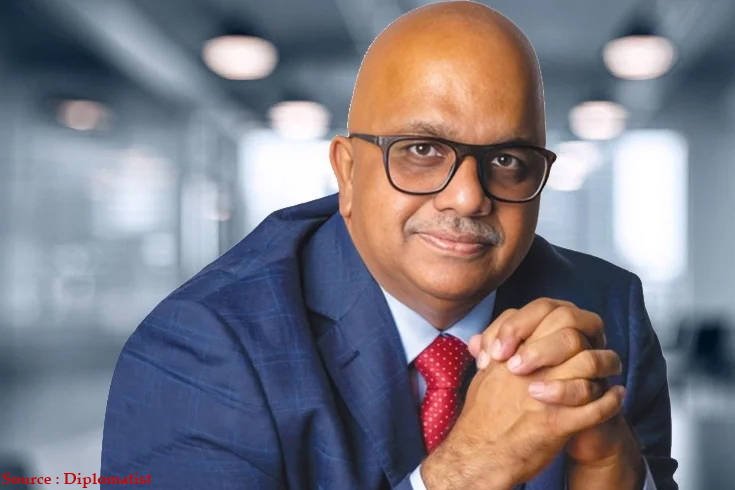
A Choice, Not a Fallback
Most
entrepreneurship stories begin with someone leaving a job. Ashok Atluri's does
not, because he never had one to leave. After finishing a commerce degree at
Osmania University and a postgraduate diploma in applied computer science from
CMC, he made a decision that, in early-1990s India, was considered almost
reckless: he skipped the job market entirely and went straight into starting a
company of his own. There was no safety net of a corporate salary to fall back
on, no cushion of industry experience to draw from. There was only a conviction
— one he would later admit was tested again and again — that he could build
something better by himself than he could by working for someone else.
In
1993, together with co-founders Kishore Dutt Atluri and Ravi Kumar, he founded
Zen Technologies in Hyderabad. The idea was almost eccentric for its time:
build indigenous, state-of-the-art simulators for weapons and defense training.
India in the early 1990s had flight simulators here and there, but nobody had
seriously considered building simulators for tanks, small arms, or combat
training on Indian soil, for the Indian military. Atluri and his co-founders
looked at that gap and, in his own words, felt a kind of childlike curiosity
and a blindness to the possibility of failure — the two ingredients, as it
turned out, that any founder chasing an unproven market needs most.
The Miserable Early Years
Atluri
has never romanticized the beginning. He has described the early years of Zen
Technologies plainly as miserable, and he has said that however meaningful the
journey looks in hindsight, he would not choose to relive it. That kind of
honesty is rare from a founder who eventually succeeded, and it says something
about how genuinely hard those first years were.
A
new business, he has said, behaves like quicksand — it keeps pulling you in,
and the only way out is to make it work, because there is no elegant way to
walk away once you are in deep. Building hardware and software for a market
that barely existed meant there was no established customer base to sell into
and no proven playbook to copy. Money had to come from wherever it could be
found: friends, relatives, and people who were willing to take a chance on an
unproven idea. Government defense procurement, the most obvious customer, moved
(and still moves) at a pace that can suffocate a small company waiting on its
next order to make payroll.
The
turning point, by Atluri's own account, came when the company made a hard
strategic choice: to stop spreading itself across general software and hardware
work and instead concentrate entirely on simulators. It was a narrowing, not a
broadening — a bet that depth in one difficult, defense-focused niche would
eventually outperform breadth across easier, more crowded markets. That focus
became the foundation for everything Zen Technologies built afterward.
Building Trust With an Institution That
Doesn't Trust Easily
Selling
to the Indian defense establishment is not like selling to a typical enterprise
customer. Procurement cycles are long, trials are rigorous, and a private
company with no track record starts every conversation from a position of
doubt. Atluri and his co-founders had to convince the army, police forces, and
paramilitary organizations that indigenous, privately built simulators could
match or beat imported alternatives — not an easy sell in an era when
"foreign-made" often carried more credibility than "Made in
India."
Rather
than lean on government grants to fund the company's research, Atluri
deliberately avoided that route. He has explained that heavy government funding
tends to come wrapped in so much monitoring and paperwork that it can choke the
very innovation it is meant to support. His approach instead was to negotiate
commitments from government buyers to purchase a certain number of units if the
product met requirements — and if it didn't, the company would receive nothing.
That structure meant Zen Technologies' own capital, and its founders' own risk,
stayed on the line the entire time, which Atluri has argued is precisely what
pushes a team to work harder: when the downside is severe enough for the people
building the product, they push past the point where a comfortably funded team
might quit.
Slowly,
contract by contract, that strategy worked. Over time, Zen Technologies built a
track record supplying simulators to Indian defense services, state police
forces, and paramilitary units, eventually delivering well over a hundred systems
to dozens of customers across the country. What began as an unproven idea
inside a small Hyderabad office became a recognized name in a sector that had
almost no domestic private players when the company started.
Public Markets, Public Scrutiny
Zen
Technologies went public in 2000, listing initially on the Hyderabad Stock
Exchange before later listing on the Bombay Stock Exchange in 2011 and the
National Stock Exchange in 2015. Going public brought capital, but it also
brought a new and unforgiving form of accountability — quarterly earnings,
analyst expectations, and a share price that would rise and fall on sentiment
as much as on fundamentals.
For
a company tied to defense budgets and government order cycles, this created a
particular kind of turbulence. There were stretches where the company posted
losses even as revenue crept upward, years when order inflows were sparse
enough to threaten momentum, and periods where the stock price would rally
sharply on a single contract announcement only to give much of it back when the
next quarter disappointed. In more recent years, after Zen Technologies became
one of the standout names in India's push toward domestic defense manufacturing
— its stock rising more than twelve-fold between 2022 and the end of 2024 on
the back of anti-drone systems and combat training products — the company also
experienced the flip side of that enthusiasm. A slowdown in order inflows and a
string of weaker quarterly results triggered sharp corrections, at times wiping
out a significant share of the stock's value within weeks. Profit margins came
under pressure as employee costs, manufacturing expenses, and other overheads
rose faster than revenue in certain quarters, a reminder that rapid growth in a
contract-driven business can be just as destabilizing as slow growth.
None
of this is unique to Atluri's company, but it illustrates a challenge
particular to founders in capital-intensive, order-dependent sectors: the
market's patience is often shorter than the defense procurement cycles the
business actually depends on. Steering a company through that mismatch, quarter
after quarter, has arguably been as demanding as anything Atluri faced in the
company's earliest, unfunded years.
A Philosophy Forged by Scarcity
What
seems to have carried Atluri and his company through both the lean early years
and the more recent public-market volatility is a fairly consistent worldview:
that skin in the game beats safety nets, that focus beats diversification for a
small player, and that training — whether of soldiers or of a company's own
instincts — matters more than having the newest equipment. He has spoken about
how the underlying conviction behind Zen Technologies was never really about
the hardware; it was about the belief that even with older equipment, a
well-trained force wins, and that gap in training was worth building an entire
company to close.
That
belief has aged well. As Zen Technologies has expanded from small arms and
driving simulators into tactical engagement systems, anti-drone technology, and
broader integrated defense solutions, the throughline connecting the 1993
startup to the present-day publicly listed company remains the same: build the
capability that others assume must come from abroad, and prove that it can be
built at home instead.
The Long View
It
would be easy to tell Ashok Atluri's story as a straightforward rise — an
entrepreneur who spotted a gap in India's defense sector and built a company
around it. But the more honest version of the story includes the years he has
openly called miserable, the reliance on borrowed money from people close to
him, the years of losses even after the company had gone public, and the recent
stretches where a stock that had once made his company a market darling shed
more than half its value in a matter of weeks. Atluri's own reflections suggest
he sees the story that way too — not as a smooth ascent but as a long test of
endurance, one where the decision to never really consider giving up mattered
more than any single product or contract.
Three
decades after he chose not to take a regular job, the company he started with
two partners and very little else has become one of the recognizable names in
India's homegrown defense technology industry — proof that the quicksand he
once described can, with enough persistence, eventually become solid ground.








.jpg)
