

Introduction
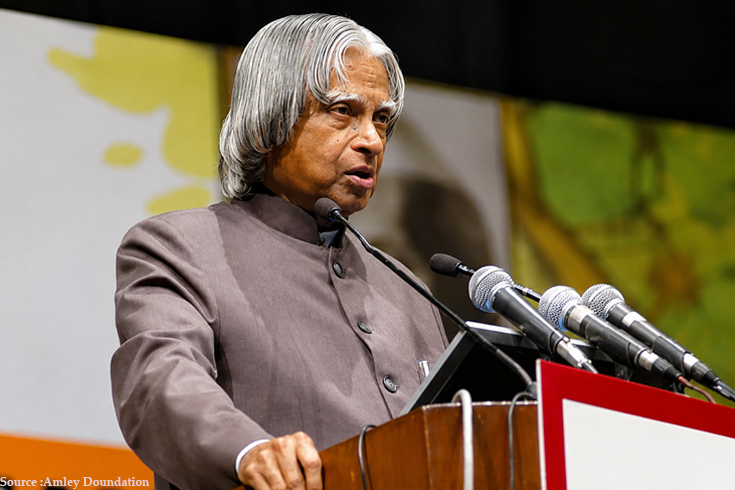
Dr. Avul Pakir
Jainulabdeen Abdul Kalam, popularly known as Dr. A. P. J. Abdul Kalam, remains
one of the most revered figures in India's history. Fondly called the
"Missile Man of India" and later the "People's President,"
Kalam's journey from a modest fisherman's family in Rameswaram, Tamil Nadu, to
becoming the 11th President of India is a story of extraordinary perseverance,
discipline, and vision. His life is not merely a tale of personal success but a
chronicle of relentless struggle, scientific brilliance, and an unwavering commitment
to strengthening India's defense and technological capabilities. This essay
explores the hardships he overcame and the monumental contributions he made
toward securing the nation.
Early Life and Struggles
Born on 15
October 1931 in Rameswaram, a small pilgrim town in Tamil Nadu, Abdul Kalam
grew up in a family of limited financial means. His father, Jainulabdeen, was a
boat owner and imam of a local mosque, while his mother, Ashiamma, was a
homemaker. The family did not have significant wealth, and young Kalam had to
contribute to household income from an early age. As a boy, he sold newspapers
to supplement his family's earnings, waking up before dawn to collect and
distribute papers before attending school.
Despite these
financial constraints, Kalam displayed an insatiable curiosity about science
and mathematics from childhood. His teachers recognized his potential, and one
incident from his school years is often cited as formative: a teacher who
initially seated him at the back of the class due to his religion later moved
him to the front row after recognizing his talent, teaching Kalam an early
lesson about merit transcending prejudice.
His pursuit of
higher education was equally challenging. He studied physics at St. Joseph's
College, Tiruchirappalli, and later pursued aerospace engineering at the Madras
Institute of Technology (MIT). Financing his education was a struggle in
itself; his sister famously pawned her jewelry to help fund his studies. At
MIT, Kalam faced a pivotal moment when a professor threatened to withdraw his
scholarship if he could not complete a challenging aircraft design project
within a tight deadline. Kalam worked continuously, without rest, and delivered
the project on time — an early demonstration of the discipline and resilience
that would define his career.
After graduating,
Kalam applied to become a fighter pilot in the Indian Air Force but narrowly
missed selection, finishing ninth in a list where only eight positions were
available. This setback could have discouraged a lesser individual, but Kalam
redirected his ambitions toward aerospace research and engineering, a decision
that would eventually allow him to serve his country in ways far beyond what a
single fighter pilot could achieve.
Entry into Scientific and Defense Research
Kalam's
professional journey began at the Aeronautical Development Establishment of the
Defence Research and Development Organisation (DRDO) in 1958. He later moved to
the Indian Committee for Space Research (INCOSPAR), which eventually evolved into
the Indian Space Research Organisation (ISRO). During this period, he worked
under the guidance of the eminent scientist Dr. Vikram Sarabhai, who became one
of Kalam's most influential mentors.
At ISRO, Kalam
played a central role in the development of India's first indigenous Satellite
Launch Vehicle, SLV-III, which successfully placed the Rohini satellite into
orbit in 1980, making India a member of an elite group of nations capable of
launching satellites using their own technology. This achievement was
significant not only scientifically but strategically, as it laid the
foundation for India's self-reliance in space and missile technology — a
cornerstone of national security independence from foreign suppliers.
The Missile Man of India
Perhaps Kalam's
most defining contribution to national security came through his leadership of
India's Integrated Guided Missile Development Programme (IGMDP), which he
spearheaded after returning to DRDO in 1982. At a time when India was heavily
dependent on foreign nations for missile and defense technology, Kalam
envisioned a self-reliant India capable of designing, developing, and
manufacturing its own strategic weapons systems.
Under his
leadership, several indigenous missiles were developed:
- Agni: A intermediate and long-range
ballistic missile series that became a cornerstone of India's strategic
deterrence capability, allowing India to project credible defense
capability against potential threats.
- Prithvi: A short-range
surface-to-surface tactical missile that strengthened India's battlefield
defense capabilities.
- Akash: A medium-range surface-to-air
missile designed to protect Indian airspace from aerial threats.
- Trishul: A short-range surface-to-air
missile developed for both the Army and Navy.
- Nag: An anti-tank guided missile
providing India's armed forces with advanced precision-strike capability
against armored threats.
These missile
systems collectively reduced India's dependency on foreign arms suppliers and
gave the country credible deterrence capability. Kalam's work in this domain
was not simply administrative; he was deeply involved in the technical
intricacies of guidance systems, propulsion, and materials science. His
hands-on leadership style, combined with his ability to inspire young
scientists and engineers, earned him deep respect within the defense research
community and the enduring title "Missile Man of India."
Pokhran-II: A Landmark in National Security
One of the most
defining moments of Kalam's career, and indeed of India's strategic history,
was his role in the 1998 Pokhran-II nuclear tests. As the Chief Scientific
Adviser to the Prime Minister and Secretary of the Department of Defence
Research and Development, Kalam played a crucial coordinating role alongside
Dr. R. Chidambaram in conducting a series of five nuclear tests at the Pokhran
range in Rajasthan.
The tests were
conducted under extraordinary secrecy, given the geopolitical sensitivity
involved and the risk of international sanctions. Kalam and his team had to
manage complex logistics, ensure operational security against foreign satellite
surveillance, and coordinate the scientific execution of the tests with
precision. The successful completion of Pokhran-II established India as a
confirmed nuclear weapons state, fundamentally altering the strategic calculus
in South Asia and giving India credible nuclear deterrence.
This achievement
carried immense strategic weight. It demonstrated India's technological
self-sufficiency in an area previously dominated by only a handful of nations,
and it reinforced the country's position as a regional and global power capable
of defending its sovereignty. Despite the international criticism and sanctions
that followed, the tests were widely regarded within India as a moment of
tremendous national pride, and Kalam became a symbol of scientific achievement
in service of the nation.
Contributions Beyond Missiles: Broader Technological Vision
While Kalam is
best known for missile and nuclear technology, his contributions to national
security extended into broader technological and strategic domains. He was a
strong advocate for indigenous defense manufacturing, believing that true
national security could not be outsourced or purchased but had to be built
through domestic capability and innovation.
He also contributed
to India's ballistic missile defense program, working on systems designed to
intercept incoming enemy missiles, an area of growing strategic importance
given regional security dynamics. Kalam consistently emphasized the integration
of defense research with civilian technological advancement, believing that
dual-use technologies could simultaneously strengthen national security and
drive economic development.
His vision
extended to "Technology Vision 2020," a roadmap he co-authored that
outlined a plan for transforming India into a developed nation through
advancements in agriculture, infrastructure, healthcare, and — critically —
strategic defense sectors. This document reflected his belief that national
security was intertwined with overall national development, technological
self-reliance, and economic strength.
Presidency and Continued Service to the Nation
In 2002, Kalam
was elected as the 11th President of India, a role he approached not as a
ceremonial position but as an opportunity to continue serving the nation,
particularly its youth. As President, he remained deeply engaged with matters
of scientific and technological advancement, often visiting research
institutions and defense establishments. He used his position to advocate for
continued investment in indigenous defense research and to inspire a new
generation of scientists and engineers.
His tenure as
President was marked by his accessibility and his particular focus on
interacting with students across the country. He believed that the future
security and prosperity of India depended on nurturing scientific temperament
among young people, and he spent considerable time delivering lectures and
engaging with students even after his presidency concluded in 2007.
Personal Struggles and Character
Beyond his
professional achievements, Kalam's life was marked by considerable personal
simplicity and sacrifice. He never married, dedicating his entire life to his
work and to the nation. Colleagues and biographers often noted his austere
lifestyle — he lived modestly, owned few personal possessions, and donated much
of his wealth and royalties to charitable causes, including funds for the
welfare of rural children and educational initiatives.
Throughout his
career, Kalam faced numerous professional setbacks, including missile test
failures. The SLV-III's first launch attempt in 1979 failed, and Kalam, who led
the mission, faced intense scrutiny and disappointment. Rather than being
discouraged, he treated the failure as a learning opportunity, working with his
team to identify and correct the technical faults, leading to the successful
launch a year later. This resilience in the face of failure became a hallmark
of his professional philosophy and is frequently cited as an inspiration for
scientists and students alike.
Later Life and Legacy
After his
presidency, Kalam continued to serve the nation as a professor, visiting
various academic institutions across India and abroad, delivering lectures on
science, education, and national development. He authored several books,
including his autobiography "Wings of Fire," which chronicled his
journey from humble beginnings to becoming a leading scientist and statesman,
inspiring millions of readers, particularly young Indians.
Dr. Kalam passed
away on 27 July 2015 while delivering a lecture at the Indian Institute of
Management Shillong, a fitting testament to his lifelong dedication to
education and inspiring young minds. His death was mourned across the nation,
with tributes pouring in from political leaders, scientists, and ordinary
citizens alike, reflecting the deep respect he commanded across all sections of
Indian society.
Conclusion
Dr. A. P. J.
Abdul Kalam's life exemplifies how individual determination, combined with
scientific vision and unwavering patriotism, can profoundly shape a nation's
destiny. From humble beginnings as a newspaper boy in Rameswaram to becoming
the architect of India's missile and nuclear capabilities, and eventually the
President of India, Kalam's journey reflects extraordinary struggle overcome
through discipline and vision. His contributions to national security —
particularly the development of indigenous missile systems and his role in the
Pokhran-II nuclear tests — fundamentally transformed India's strategic
capabilities and reduced its dependence on foreign powers for critical defense
technology.
Beyond his technical achievements, Kalam's legacy lies in the values he embodied: humility despite immense achievement, resilience in the face of failure, and an unwavering belief that scientific progress must serve the broader goal of national development and security. He remains an enduring symbol of what dedicated service to one's nation can achieve, inspiring generations of scientists, engineers, and citizens to contribute toward building a stronger, more self-reliant India.







.jpg)
